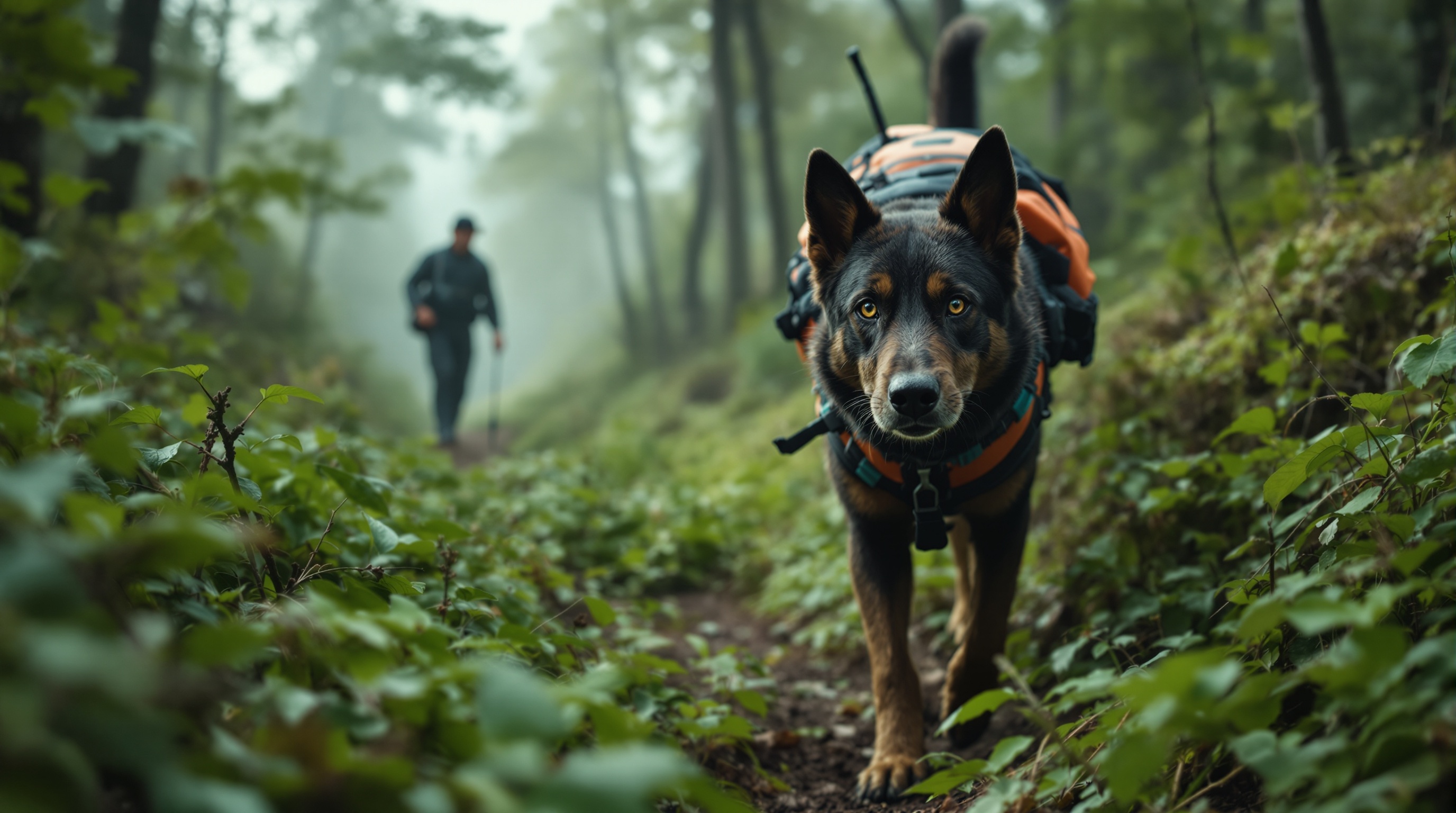
K9 Search Dogs: How They Find Missing Persons
K9 search dogs are one of the most effective tools in missing persons investigation. Their capabilities border on extraordinary — a trained search dog can detect a single human scent particle among millions of competing odors, track a trail hours or days old, and cover terrain that would take human searchers ten times as long.
At SEARCH Investigations, we coordinate with certified K9 teams on cases across the country. Understanding how these dogs work — and when to deploy them — is critical knowledge for any family dealing with a missing loved one.
How Scent Works
Every human sheds approximately 40,000 skin cells per minute. Each cell carries bacteria that produce a unique scent profile — your individual "scent signature." This scent falls to the ground, clings to vegetation, and drifts on air currents.
A search dog's nose contains up to 300 million olfactory receptors, compared to about 6 million in a human nose. They can detect scent concentrations as low as one part per trillion. To put that in perspective: if you dissolved a teaspoon of sugar in an Olympic swimming pool, a trained dog could detect it.
Live Find Dogs vs. Cadaver Dogs
These are two distinct specialties requiring different training.
Live Find Dogs (also called trailing dogs or area search dogs) are trained to follow the scent trail of a living person. They can work from a scent article — a piece of the missing person's unworn clothing, a pillowcase, or personal item — and follow that specific person's trail through neighborhoods, trails, urban areas, and wilderness.
Cadaver Dogs (Human Remains Detection or HRD dogs) are trained to detect the scent of human decomposition. These dogs can find remains that have been buried, submerged in water, or concealed for years. They are an essential tool in recovery operations and cold cases.
Some dogs are cross-trained, but specialists tend to perform better in their specific discipline.
Terrain Capabilities
Trained search dogs work effectively across virtually all terrain: dense forest, open fields, urban environments, rocky hillsides, and even water edges. Cadaver dogs can work from boats to detect remains in lakes and rivers, as the decomposition gases rise to the surface.
Weather affects scent behavior. Warm, humid conditions help scent linger and are generally favorable. Cold, dry conditions can diminish scent, but experienced dogs still perform. Rain can temporarily wash scent from surfaces, but it also concentrates scent in drainage patterns. Wind can carry scent long distances, which skilled handlers use to their advantage.
When K9s Are Deployed
We deploy K9 teams in several scenarios: when we have a last known location and need to establish a direction of travel, when we need to clear a specific search area, when searching dense vegetation or terrain that drones cannot fully penetrate, during recovery operations when remains are suspected, and in cold cases where suspected burial sites need to be searched.
K9 search is most effective when deployed early — ideally within the first 24-48 hours. But cadaver dogs, in particular, remain effective months and years after a disappearance.
Working with Drones
K9 teams and thermal imaging drones are complementary technologies, not competing ones. In our operations, we frequently deploy drones first to identify areas of interest — heat signatures, disturbed ground, objects — then send K9 teams to those specific locations for ground-level confirmation.
This combination multiplies the effectiveness of both tools and allows us to cover more ground with greater accuracy than either technology alone.
Choosing the Right K9 Team
Not all K9 teams are equal. Look for dogs and handlers who are certified by recognized organizations, train regularly, and maintain detailed documentation of their deployments and results. The handler matters as much as the dog — reading canine behavior accurately is a skill that takes years to develop.
If your loved one is missing and you need K9 search capabilities, call SEARCH Investigations: (877) 619-9890. We coordinate with certified K9 teams nationwide.