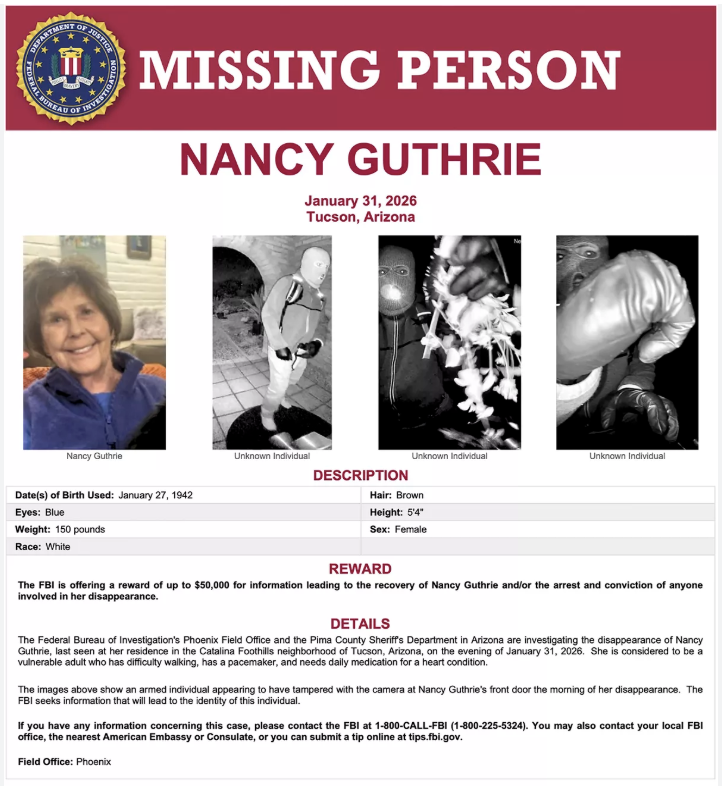
The disappearance of Nancy Guthrie, an 84-year-old woman taken from her home in Tucson, Arizona, has become one of the most unusual and complex missing person investigations in recent years. Since the case began, federal and local law enforcement agencies, including the FBI and Pima County Sheriff’s Department, have deployed advanced forensic tools, executed search warrants, and responded to ransom demands reportedly totaling millions of dollars.
Despite these efforts, Nancy Guthrie remains missing, and investigators continue working to determine whether this case is a legitimate kidnapping for ransom, an act of revenge, or an extortion attempt by someone who may not have her at all.
As a private investigator specializing in missing persons cases, I have discussed this investigation on CNN and Court TV and have closely analyzed the publicly available evidence and search methods being deployed.
The Disappearance of Nancy Guthrie Is Extremely Rare
Kidnappings involving elderly victims, especially individuals in their 80s, are extraordinarily rare. Most kidnappings target individuals who are easier to transport and control, or who have direct financial leverage through employment, business, or family connections.
An 84-year-old victim presents unique challenges for offenders, including:
- Increased medical risk and potential need for medication
- Reduced mobility, requiring physical assistance to move
- Increased risk of death during transport or confinement
- Increased investigative urgency from law enforcement
These factors make elderly ransom kidnappings uncommon and raise legitimate questions about motive.
Investigators must consider whether this was truly a ransom-motivated abduction or whether the ransom demands emerged after the fact as part of an extortion attempt.
Ransom Demands and the Possibility of Extortion
Public reports indicate that ransom demands in the Nancy Guthrie case reached as high as $6 million. In any kidnapping investigation, law enforcement must verify whether ransom communications are legitimate or whether someone is attempting to exploit the situation.
Investigators look for several key indicators:
- Proof that the sender actually has the victim
- Information not publicly known
- Consistent communication patterns
- Traceable digital or financial activity
Families understandably want to act immediately to protect their loved one. Law enforcement, however, must take a longer investigative view, ensuring that actions taken do not place the victim at greater risk or reward individuals who may not be responsible.
It is not uncommon in high-profile cases for individuals unrelated to the disappearance to attempt extortion once the case becomes public.
Surveillance Footage Shows a Planned Approach
Surveillance footage released publicly shows a masked individual approaching Nancy Guthrie’s home and removing a Nest surveillance camera. This action demonstrates awareness of surveillance and suggests planning rather than spontaneous activity.
The footage confirms several investigative realities:
- The individual intentionally approached the residence
- The individual was aware of the camera and removed it
- The act occurred under cover of darkness
- The suspect appears to be acting calmly and deliberately
However, surveillance footage alone cannot confirm whether the individual acted alone or whether additional individuals were involved outside the camera’s field of view.
Advanced Technology Being Used: BlueFly RF Signal Detection
One of the most notable aspects of the Nancy Guthrie investigation is the use of advanced radio frequency detection technology, including systems capable of detecting low-power electronic emissions.
The specific type of technology commonly used in these situations is the BlueFly system, a portable radio frequency (RF) detection platform designed to locate signals from devices such as:
- Cell phones
- Bluetooth-enabled medical devices, including pacemakers
- Wireless electronics
- Other RF-emitting devices
I have personally used the BlueFly RF detection system in three separate search and rescue operations, including wilderness missing person searches coordinated with law enforcement and search teams. The system is designed to detect faint electronic signatures even when devices are not actively transmitting conventional signals.
These searches typically require aircraft or low-altitude aerial platforms flying slowly and close to the ground to detect weak signals.
The use of this technology in the Nancy Guthrie case indicates investigators are attempting to locate any electronic signal associated with her pacemaker.
This is not a tool used in routine investigations and reflects the seriousness and complexity of this case.
Property Searches, Septic Tank Searches, and Evidence Recovery
Investigators have executed search warrants and conducted property searches, including examining concealed areas such as septic systems. These searches are often misunderstood by the public.
Searching concealed locations allows investigators to determine whether any evidence was intentionally hidden or discarded, including:
- Clothing
- Personal belongings
- Electronic devices
- Weapons
- Biological trace evidence
These searches do not automatically indicate investigators believe the victim is deceased. They are part of a systematic process of ruling out possibilities and preserving evidence.
Investigations progress as much by eliminating scenarios as by confirming them.
Tactical Operations and Search Warrants Are Investigative Steps, Not Conclusions
Law enforcement has executed search warrants and deployed tactical teams to secure locations connected to the investigation. Tactical units such as SWAT are used to secure scenes safely before forensic investigators enter.
Search warrants are issued based on probable cause that evidence may be present, not certainty of guilt.
Even when no arrest immediately follows, searches often produce critical forensic and digital evidence that investigators analyze over time.
Many important investigative developments occur weeks or months after initial searches once forensic analysis is complete.
The $1 Million Reward and the Role of Private Investigators
Nancy Guthrie’s family has now offered a $1 million reward for information leading to her safe return. Rewards of this magnitude significantly increase the likelihood that individuals with information may come forward.
In complex missing person cases, families sometimes retain private investigators and independent search teams to assist alongside law enforcement.
Private investigators can help by:
- Running down tips generated by media coverage and reward offers
- Conducting independent digital analysis
- Locating and interviewing witnesses
- Deploying specialized search equipment
- Following investigative leads quickly
Some individuals may be reluctant to speak directly with law enforcement but may be willing to speak confidentially with a private investigator. Independent investigative efforts can complement law enforcement resources and expand the reach of the investigation.
This approach is commonly used in high-profile missing person cases.
Where the Nancy Guthrie Investigation Stands Now
The disappearance of Nancy Guthrie remains an active investigation involving federal and local law enforcement agencies. Advanced forensic tools, RF signal detection technology, and ongoing searches demonstrate the seriousness of the investigative effort.
However, key questions remain unanswered:
- Whether the ransom demands are legitimate
- Whether the individual seen on surveillance acted alone
- What the true motive may be
- Where Nancy Guthrie is currently located
Cases involving planned abductions and digital evidence often require extensive forensic analysis before definitive answers emerge. The priority remains the safe recovery of Nancy Guthrie.
About the Author
Steve Fischer is a licensed private investigator and founder of Search Investigations, specializing in missing persons investigations and search operations. He has assisted families and law enforcement in complex missing person cases throughout the United States and has extensive experience using advanced search technologies, including RF signal detection systems such as BlueFly.